Abstract
Shortly after the presidential election of March/April 1932, in which
Hindenburg was reelected, German voters were called upon to vote in a
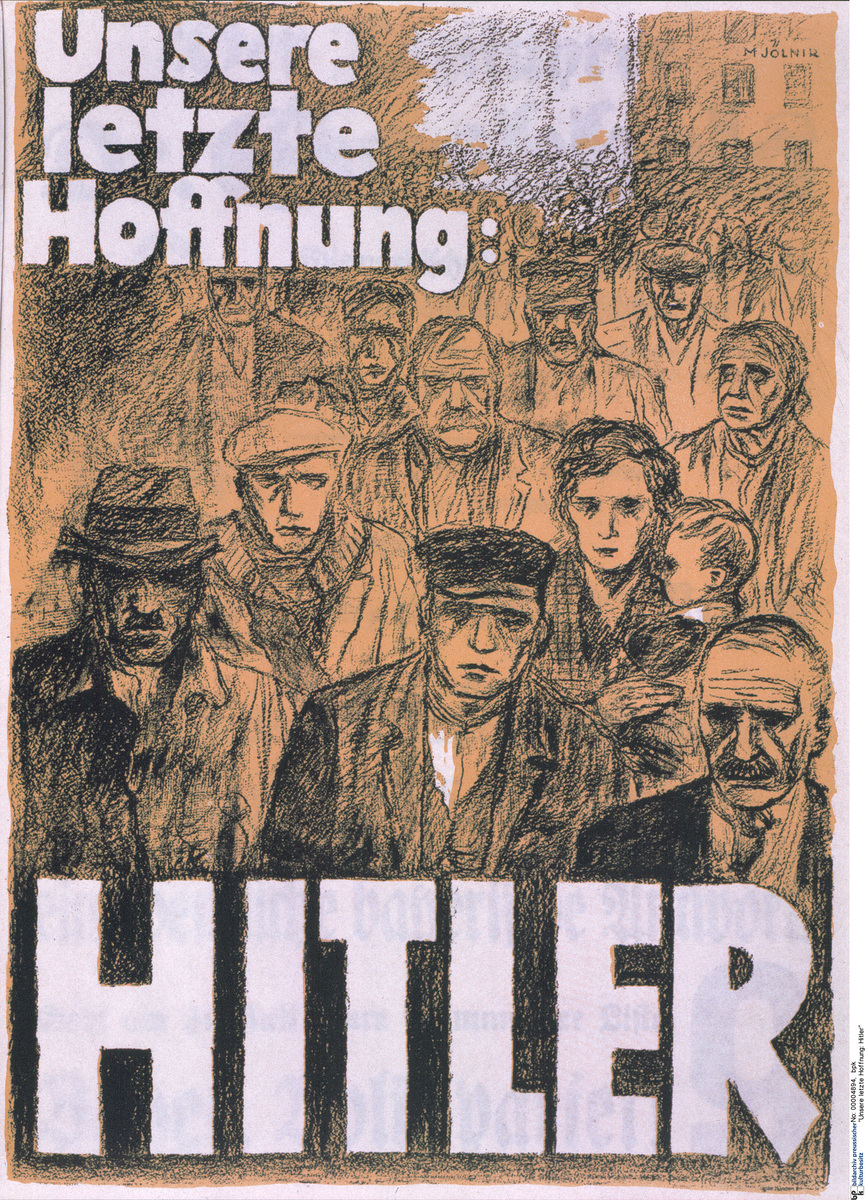
Reichstag election on July 31, 1932. This NSDAP election poster reflects
the population’s overall circumstances, which were characterized by
economic depression, mass unemployment, and poverty. The signature
“Mjölnir” identifies it as the work of Hans Herbert Schweitzer, one of
the best-known graphic artists in the National Socialists' employ.
During an election campaign marked by riots and extremist violence,
several cities saw street fighting and battles in meeting halls between
the SA, the Communist Rotfrontkämpferbund, and the Reichsbanner
Schwarz-Rot-Gold, in which numerous people were killed. The government
reacted by declaring a state of emergency in the capital of Berlin,
where riots were considered particularly dangerous. This enabled the
ouster of the Social Democrat-led Prussian government in the so-called
“Preußenschlag” [“Prussian Coup”]. On election day, voter turnout was
remarkably high at 84.1%. The NSDAP, profiting from the dismal economic
and political situation, received 37.3% of votes, thus becoming the
strongest party in the Reichstag. They did not win an absolute majority,
however. NSDAP voters came from all segments of society and had drifted
from parties across the political spectrum. The drastic loss of support
for the democratic center parties proved to be particularly fateful for
the Republic. Since no government could be formed due to the
distribution of mandates, new elections were held in November of the
same year. The NSDAP lost a relatively small number of votes, still
reaching 33%.