Abstract
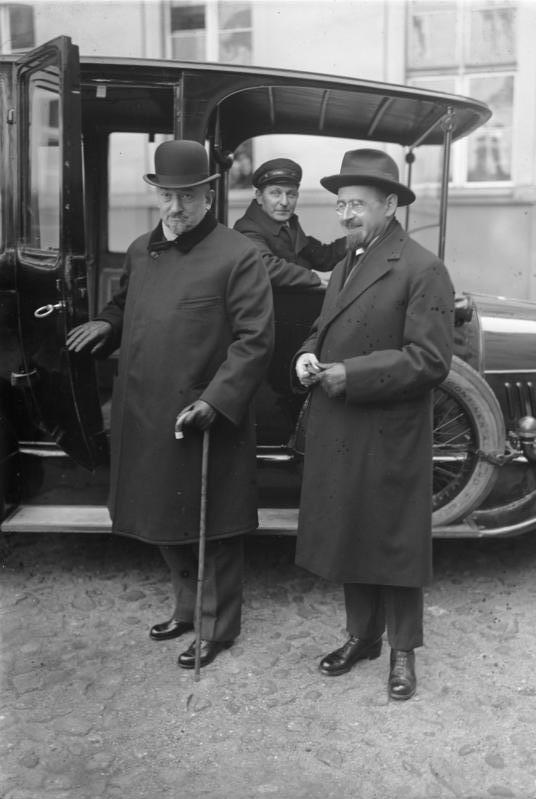
Russian foreign minister Georgy Chicherin (left), who had signed the
Treaty of Rapallo normalizing relations with Germany just two years
earlier, traveled to Berlin in September 1925 to meet with German
foreign minister Gustav Stresemann on the eve of his departure to
Locarno. The Soviet Union, which was unsettled by the prospect of
Germany’s integration into a Western anti-Bolshevik bloc, regarded any
separate agreement between Germany and the Western Allies as a violation
of the Rapallo treaty. It took a similar view of Germany’s entry into
the League of Nations (of which the Soviet Union was not a member).
Chicherin’s pro-German foreign policy was greatly abetted by his
friendship with Ulrich von Brockdorff-Rantzau, Germany’s ambassador to
the Soviet Union, whose infamous remark the previous December about
“driving Poland back to its ethnographic frontiers”
[Polen auf seine ethnographischen Grenzen
zurückzudrängen], had been interpreted by the Russians as a sign of
Germany’s interest in military cooperation with the Soviets. Russian
concerns would be addressed in the Treaty of Berlin, which was signed
after the ratification of the Locarno Treaty and just prior to Germany’s
entry into the League of Nations in September. Nikolay Krestinsky
(right) was the Russian ambassador to Germany and a signatory to the
Treaty of Berlin on April 24, 1926. One of the defendants in the Trial
of the Twenty One, the last of the Moscow show trials, he was executed
on March 15, 1938.