Source
Source: Anthony McElligott, Rethinking the Weimar Republic: Authority and Authoritarianism, 1916-1936 (London: Bloomsbury Publishing, 2014), p. 27. Cartography by Gabriel Moss in collaboration with Erik Jensen, 2022.
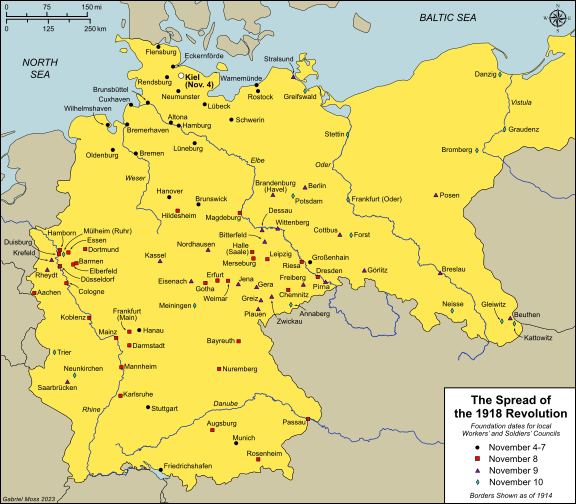
The 1918 revolution, or German November Revolution, spread rapidly from a naval mutiny in Kiel and Wilhelmshaven across the German Empire as soldiers and workers declared strikes and formed councils in solidarity. By November 7, Soldiers' and Workers' Councils took power in the northern cities of Hamburg, Bremen, and Lübeck, and the revolution spread further to Braunschweig and Cologne. In Munich, on November 7-8, 1918, the Provisional Workers', Peasants' and Soldiers' Council elected journalist Kurt Eisner of the Independent Social Democrats (USPD) as the first Prime Minister of the newly proclaimed republican Free State of Bavaria. By November 8, the revolution reached Dresden, Leipzig, Frankfurt, Cologne, and Stuttgart, among other cities. The Revolution culminated in a general strike and mass demonstrations in Berlin on November 8-9, 1918, demanding an end to the war and monarchy. On November 9, 1918, Philipp Scheidemann declared the German Republic from the Reichstag balcony and it was announced that Kaiser Wilhelm II had abdicated. On November 10, 1918, the Council of People’s Deputies, led by Friedrich Ebert, was formed as Germany's provisional government while additional workers and soldiers’ councils were established in smaller cities like Mühlheim/Ruhr. The Revolution provided the foundation for establishing the Weimar Republic as a parliamentary democracy with universal suffrage.
Source: Anthony McElligott, Rethinking the Weimar Republic: Authority and Authoritarianism, 1916-1936 (London: Bloomsbury Publishing, 2014), p. 27. Cartography by Gabriel Moss in collaboration with Erik Jensen, 2022.