Source
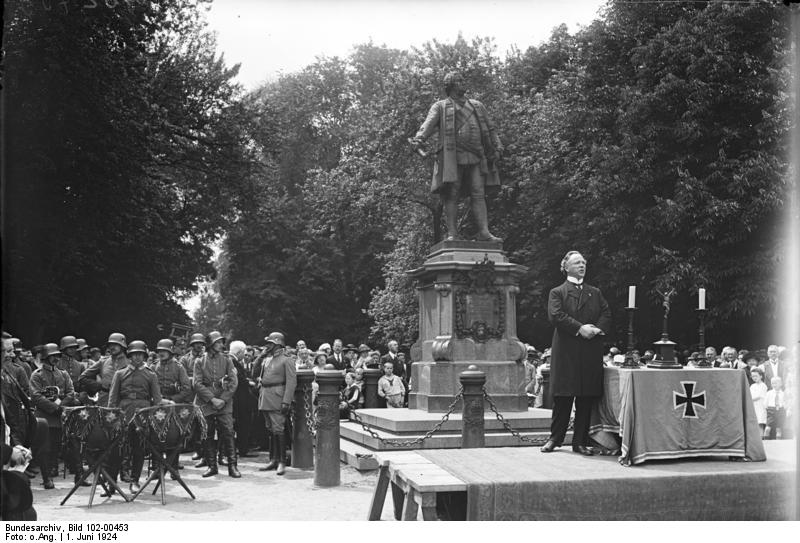
On June 1, 1924, a “Service of Intercession [a ceremony asking for God’s blessing] for the Rhine, Ruhr, and Palatinate” was held in the Lustgarten park in Potsdam. Protestant pastor Esser from Berlin, who gave the sermon, can be seen in the foreground standing on the platform next to the altar decorated with the Iron Cross. Uniformed men, presumably members of the Reichswehr, can be seen behind him on the left, while service attendees in civilian clothes can be seen in the background on the right. The altar is set up directly in front of the monument to Frederick William I, the Prussian “Soldier King,” who had part of this palace garden, built at the end of the sixteenth century, converted into a military parade ground. Intercessory prayers, which ask for God’s protection and blessing of a community, are part of both the Protestant and Catholic traditions, and they are an especially prominent feature of services held on the fifth Sunday after Easter Sunday. In this case, the intercession was made for the Rhineland and the Palatinate, which had been occupied by French and Belgian troops since the end of the First World War, as well as the Ruhr region, which had been occupied since January 1923. The Protestant Church, which had close ties to the monarchy and thus to the imperial government during the Kaiserreich, especially in Prussia, was dominated by clergy with a national-conservative outlook during the Weimar Republic. Church leaders often criticized the separation of church and state, rejected the position that Germany should fulfill the stipulations of the Treaty of Versailles, and hoped for a return of the monarchy.
wikimedia commons
