Abstract
While hyperinflation and the occupation of the Ruhr area in 1923 had
thrown Germany into an economic and political crisis that threatened to
spiral out of control, both the political Left and Right called for the
deposition of the Weimar government. Bavaria had developed into a
stronghold of anti-democratic sentiment during the first years of the
Republic, as not only the Republic’s centralist structure met with
resistance, but also its left-wing government in the capital Berlin, a
city decried as a “bastion of sin.” In Munich, Adolf Hitler, by now
party leader of the Nazi Party (NSDAP), attempted an armed coup on
November 8-9, 1923 to depose the government in Berlin and install
himself as dictator. For military support he called on General Erich
Ludendorff. The putsch quickly failed however, and Hitler and his
supporters were stopped by the Bavarian state police. 20 people died in
the armed clashes. After the attempted putsch, the NSDAP was banned
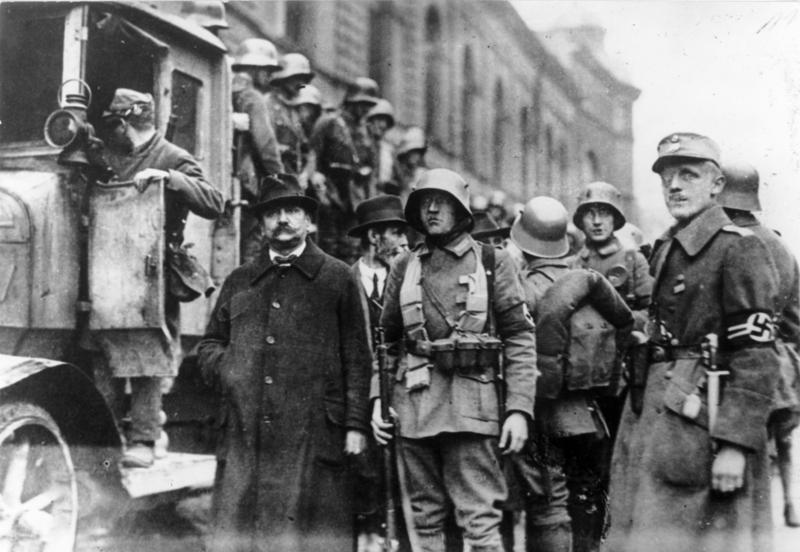
nationwide. This photo taken on November 9, 1923 shows putschists
arresting members of the Munich city council after they had declared the
local government deposed. The heavily armed putschists are wearing
Reichswehr uniforms while a member of the SA, identified by his swastika
armband, can be seen on the right.