Abstract
During the revolution of 1918/19 the economically significant
princely estates owned by the dynasties that ruled until 1918 were
confiscated but not expropriated by the new government. While the Weimar
Constitution, which was ratified in 1919, guaranteed private property,
it also allowed for the possibility for expropriations “for the benefit
of the public.” The nobility now demanded the return of their
confiscated properties as well as compensation for lost income. While
the population still suffered the consequences of war and inflation,
several courts decided in favor of the noble families, which caused
outrage among large segments of the public. The KPD demanded the
expropriation of the princely estates to relieve poverty among the
general population, a demand that was supported by the SPD. A draft law
to that effect was rejected by the Reichstag, however, and the KPD and
the SPD subsequently tried to effect an expropriation without
compensation by plebiscite. But when the plebiscite occurred on June 20,
1926, only 36% instead of the required 50% of voters backed the demand
for expropriation. Instead, most state governments subsequently signed
individual compensation agreements with the princely dynasties. This
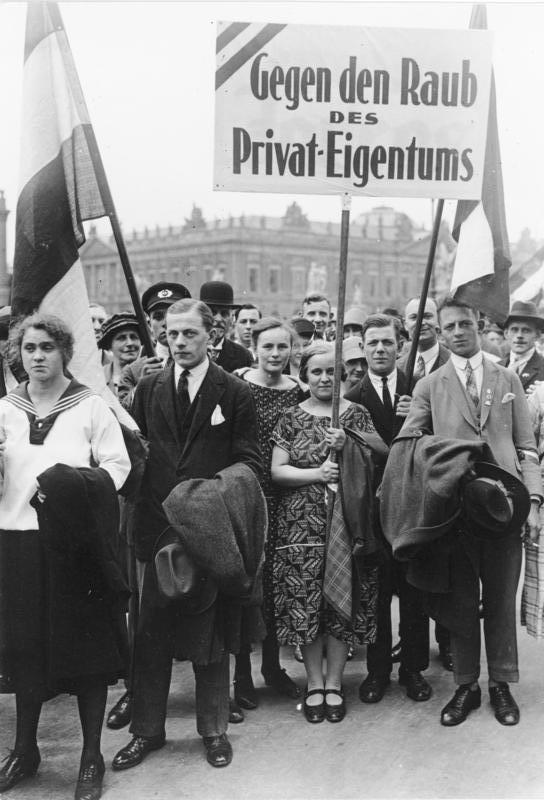
photograph shows participants in a mass rally organized by the DNVP
against the proposed expropriation. The rally was held at Berlin’s
Lustgarten. The City Palace, the Berlin residence of the Hohenzollern
dynasty, is visible in the background. The protestor's sign reads
"Against the robbery of private property." In addition to the
DNVP, the DVP, both Christian churches, and Reich President Paul von
Hindenburg were among the opponents of expropriations.