Abstract
In July 1930, Reich President Hindenburg dissolved the Reichstag when
its delegates refused to support Chancellor Brüning’s budgetary policy.
When Brüning, in an unconstitutional act, had put a draft law into
effect by means of emergency decree after the Reichstag had vetoed his
draft, the SPD filed a motion to repeal this emergency decree. The
Reichstag passed the motion, in reaction to which President Hindenburg
applied Article 25 of the Constitution to dissolve that parliamentary
body. Elections were scheduled for September 14, 1930. While the SPD
again became the strongest party despite a significant loss of mandates,
the NSDAP won 18% of votes, thus becoming the second strongest party
group. The KPD, too, gained votes, as did the
Zentrum party. The losers of this
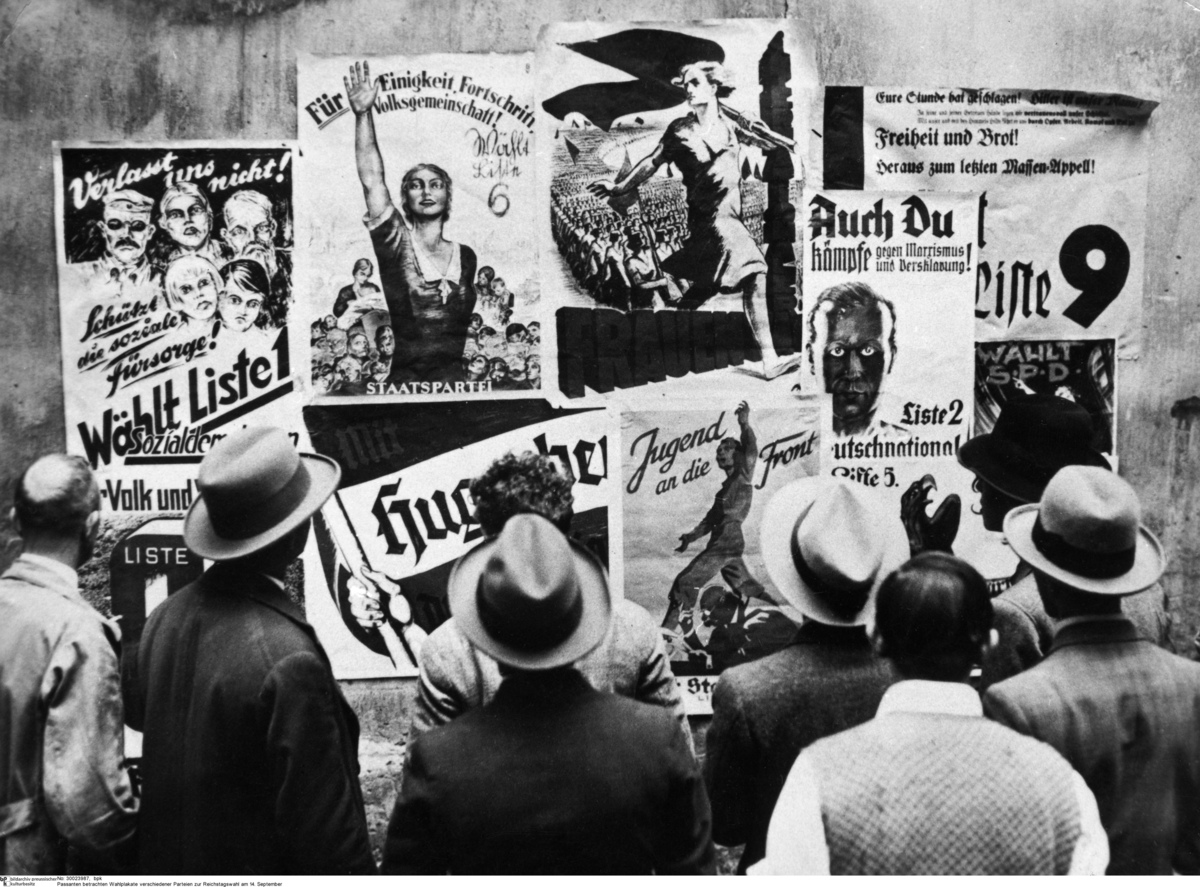
election were the DNVP, DDP, and DVP. This photo shows passersby looking
at various election posters, among them posters for the SPD,
Staatspartei, and DNVP. 82% of those
eligible to vote went to the polls. The political polarization which
became apparent in the election results reflected both the uncertainty
caused by the dire economic and social situation and the frustration
with the continued political instability which appeared to disqualify
the political parties as the pillars of parliamentary democracy.