Abstract
During his brief time in office as Reich Chancellor from August until
November 1923, the economist and national-liberal politician Gustav
Stresemann (1878-1929) ordered the cessation of passive resistance to
the occupation of the Ruhr Valley and managed to end the devastating
inflation by introducing both a currency reform and the
Deutsche Rentenbank [German Mortgage
Bank]. After he stepped down as Chancellor, he served as foreign
minister in the next three cabinets and pursued a policy of
reconciliation with the Allies in order to integrate Germany back into
the international community. Among his successes were the negotiation of
the Dawes Plan, the treaties of Locarno, Germany’s admission to the
League of Nations, and the Briand-Kellogg agreement. In 1926, Stresemann
and French foreign minister Aristide Briand were awarded the Nobel Peace
Prize. When Stresemann, who had suffered from ill health for quite some
time, died after a stroke in October 1929, the Weimar Republic lost one
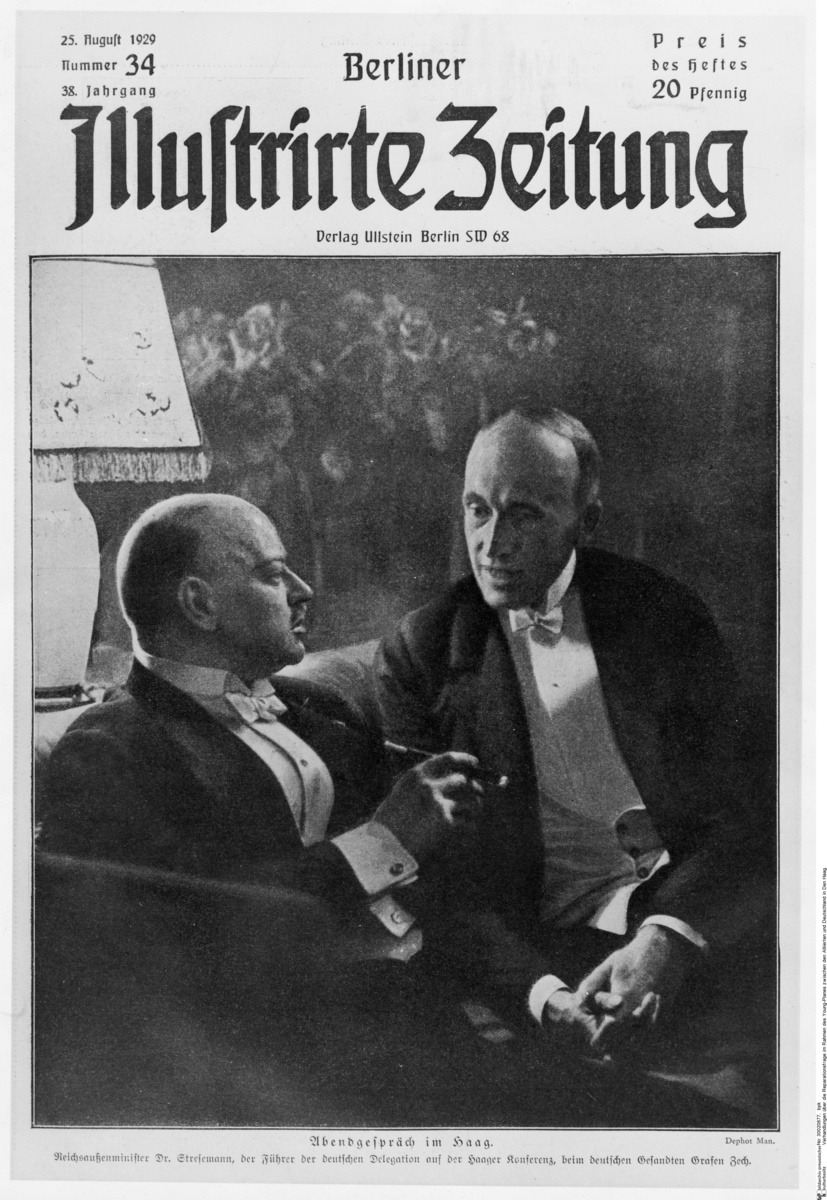
of its most important and capable politicians. This cover photo taken
from the magazine Berliner llustrirte
Zeitung shows Stresemann in August 1929, two months before his
death, in The Hague, where he was participating in negotiations about
reparations which were to result in the Young Plan. He is seen in
conversation with Julius von Zech-Burkersroda (1885-1946), who served as
German ambassador to The Hague since 1928. Zech joined the NSDAP in 1934
and remained in his post until the German occupation of the Netherlands
in 1940. After the end of World War II, the Soviet occupation forces
expropriated his estate and interned him in the Bautzen prison camp,
where he died in 1946.