Source
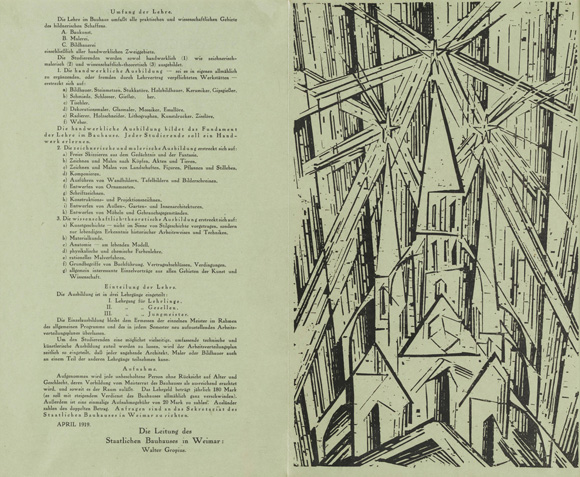
Source: Reproduction: Artists Rights Society (ARS), New York. Digitized originals are available from Yale University Library, among other repositories: https://collections.library.yale.edu/catalog/2107189
The Bauhaus School was founded in Weimar by architect Walter Gropius, who, on April 1, 1919, published a four-page manifesto and program declaring the goals and methods of this new kind of art school. “The ultimate aim of all visual arts is the complete building!,” Gropius stated. “The artist is an exalted craftsman.” Paradoxically, the Bauhaus (or “building house”) did not actually have an architecture department at first, with this only being established after the school’s move to Dessau in 1925. The title page of Gropius’ manifesto and program was a woodcut of a cathedral by artist Lyonel Feininger, who was in charge of the school’s graphic printing workshop. The image is a reference to the medieval cathedral guilds, which Gropius saw as models of teamwork and community among craftsmen, and it reinforced the notion of the primacy of architecture at the school.
Source: Reproduction: Artists Rights Society (ARS), New York. Digitized originals are available from Yale University Library, among other repositories: https://collections.library.yale.edu/catalog/2107189