Abstract
The charismatic prophet Joseph Weißenberg gained a following in the
first third of the twentieth century for his purported ability to cure
people of their ailments by laying on of hands and a type of fresh
cheese known as quark. At the height of his fame, Weißenberg had the
ability to hold hundreds of thousands in rapt attention, and in 1926 he
founded his own church. The self-described “Weißkäseheiler”
(white-cheese healer) had attracted such a dedicated following that some
of his flock took all of their money and possessions and joined him in
building a new town for believers, located about 30 kilometers south of
Berlin. Dubbed “Friedensstadt” (City of Peace), Weißenberg and his
followers broke ground in December 1920 and eventually completed a large
church, a clinic and spa for healing practices, a water works, homes,
and a school. By the time of Friedensstadt’s completion it ranked as one
of the largest private settlements in Germany.
Weißenberg later faced criminal charges in a November 1930 case that
grabbed headlines in Berlin, both because of Weißenberg’s celebrity and
because it involved a child who had gone blind after receiving one of
his “Miracle Quark” [Zauber-Quark] treatments. Initially sentenced to
six months in prison, an appeals court later exonerated Weißenberg, and
even the baby’s parents forgave him. The case had become so well-known
that Kurt Weill even wrote a satirical song about it called “Das Lied
vom weißen Käse” [The Song of White Cheese].
Weißenberg was just one of many charismatics, prophets, faith
healers, and spiritual gurus who managed to fascinate and then captivate
people during the Weimar Republic. Particularly in times of upheaval and
uncertainty, some Germans sought hope and guidance through radical
self-renewal or in the support that came from tight-knit communities of
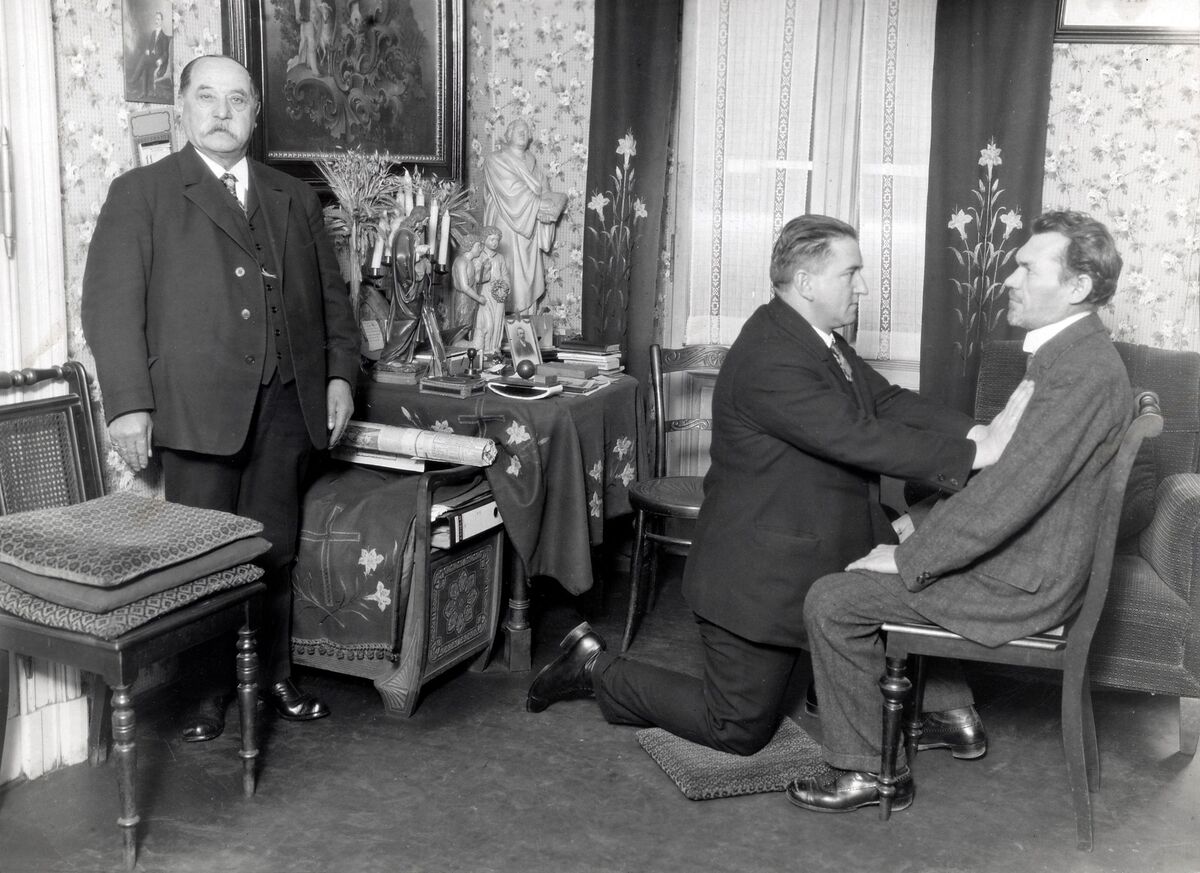
fellow believers. This photo taken in 1928 shows Weißenberg (left) and
one of his “mediums” [Werkzeuge] who, like him, were supposedly able to
heal the sick by laying on of hands.
_legt_bij_een,_SFA022006080.jpg)