Source
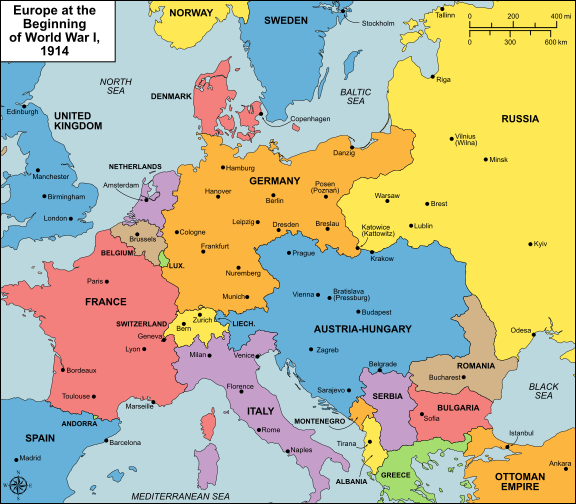
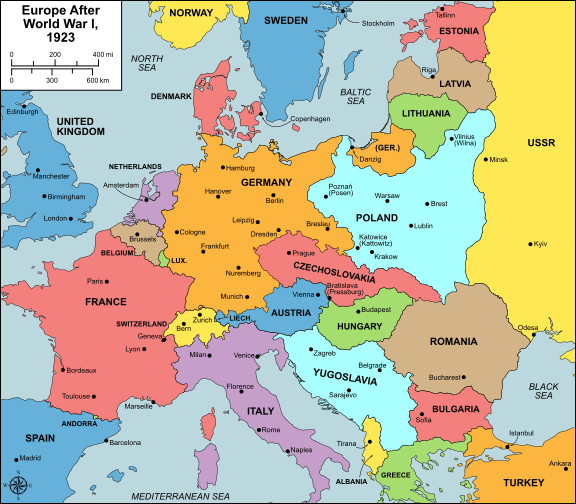
Source: “How WW1 Changed the Map of Europe,” BBC Teach, https://www.bbc.co.uk/teach/articles/zf4cscw. Cartography by Gabriel Moss in collaboration with Erik Jensen, 2022.
These maps, showing Europe before and after the First World War, highlight the fundamental ways in which the outcome of this global war reordered the geopolitical situation in Central Europe. Following Germany’s defeat, the collapse of the Austrian-Hungarian Empire, and the signing of the Treaty of Versailles (1919), Germany lost significant parts of its European territory and all of its overseas colonies. The Treaty of Versailles forced Germany to cede Alsace-Lorraine to France and paved the way for re-establishing Poland as an independent nation. Germany ceded large portions of its eastern Prussian territories to Poland, including the "Polish Corridor" granting Poland access to the Baltic Sea. Following the dissolution of the Russian Empire, Finland, Estonia, Latvia, and Lithuania gained national independence. Czechoslovakia was formed from territories of the Austro-Hungarian Empire, as was Yugoslavia, which included territories previously under Habsburg rule (Slovenia, Croatia, Bosnia & Herzegovina) and the independent kingdoms of Serbia and Montenegro. The Soviet Union (USSR) was formally established in December of 1922 following the 1917 October Revolution and the proclamation of the Russian Soviet Republic.
Source: “How WW1 Changed the Map of Europe,” BBC Teach, https://www.bbc.co.uk/teach/articles/zf4cscw. Cartography by Gabriel Moss in collaboration with Erik Jensen, 2022.