Source
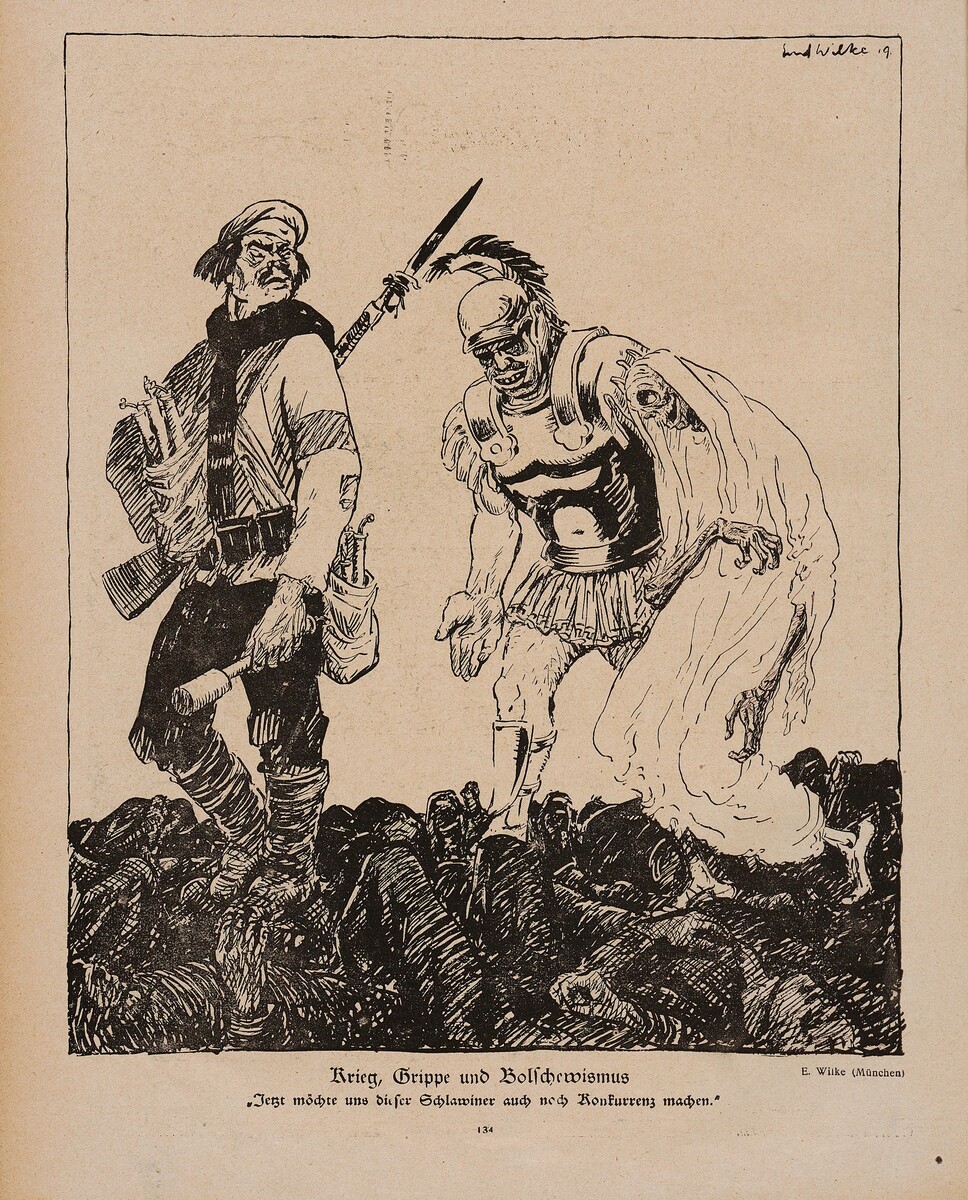
Source: Erich Wilke, “Krieg, Grippe und Bolschewismus,” Die Jugend. Münchner illustrierte Wochenschrift für Kunst und Leben 24, No. 7 (1919), p. 134. Available online: https://digi.ub.uni-heidelberg.de/diglit/jugend1919_1/0134
This bitterly satirical 1919 cartoon depicted the suffering that had befallen Germany since autumn 1918 in the form of three figures representing Bolshevism (on the left), War (in the center), and the skeletal figure of the Spanish Flu pandemic (on the right). War has one hand around Spanish Flu and gestures with the other to the pile of dead bodies over which they walk. War says to Spanish Flu, “Now this rascal [Bolshevism] wishes to give us some competition.” (“Jetzt möchte uns dieser Schlawiner auch noch Konkurrenz machen.”)
The cartoon underscored the misery and death wrought by the previous four years of war and the previous six months of the flu pandemic. It further suggested that far-left revolutionary activity, which had begun just a few months earlier in November 1918, rivaled the other two as a source of national misfortune. Such a suggestion grossly exaggerated the threat posed by Bolshevism, relative to the millions of German deaths caused by the war, and the hundreds of thousands of deaths caused by the Spanish Flu pandemic. Revolutionary activity in Germany, on the other hand, had, by this point, led to perhaps a few thousand deaths, with those of the revolutionaries far exceeding those of the forces suppressing the revolution, let alone those of non-participating bystanders.
The Spanish Flu, meanwhile, had registered its highest rates of infection and death in Germany in late October and November 1918, just as the military front was collapsing and the country roiled with demands for political change. American soldiers arriving in France in spring 1918 had unwittingly brought the virus with them to the continent, and, by that summer, it was spreading rapidly throughout western and central Europe. Young people succumbed more easily to the disease than older people, who had lived through earlier flu epidemics and so enjoyed some resistance or immunity. People in their late teens and twenties registered the highest death rates, precisely the same age group that combat deaths had already disproportionately affected. The pandemic therefore skewed Germany’s demographic imbalance even further still.
The illustrator and caricaturist who produced this particular cartoon, Erich Wilke (1879-1936), came from a remarkably creative and artistic family. Two of his brothers, Rudolf (the eldest and most famous of the three) and Hermann, also produced impressive portfolios of work, and Rudolf had initially connected Erich to the Munich arts magazine Die Jugend, in which this cartoon appeared. Rudolf, by that point, had begun publishing with a rival satirical magazine in Munich, Simplicissimus, which helped him to achieve great renown. Hermann stayed in northern Germany, and he published his works mostly in Berlin journals, including another satirical magazine popular at the time, Ulk. Erich Wilke published continuously and prolifically throughout the Weimar Republic and up until his death in spring 1936.
Source: Erich Wilke, “Krieg, Grippe und Bolschewismus,” Die Jugend. Münchner illustrierte Wochenschrift für Kunst und Leben 24, No. 7 (1919), p. 134. Available online: https://digi.ub.uni-heidelberg.de/diglit/jugend1919_1/0134
UB Heidelberg