Source
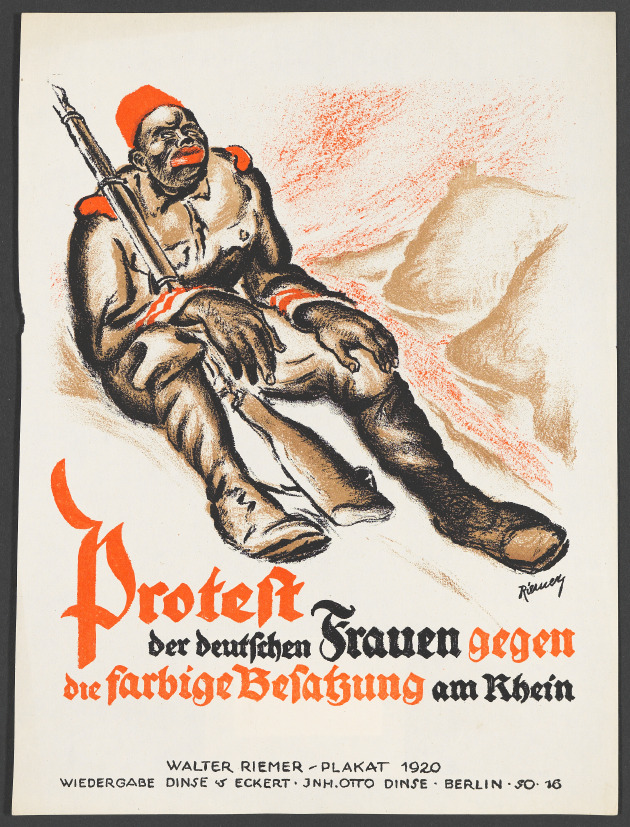
Source: Poster, 1920. Artist: Walter Riemer. Deutsche
Nationalbibliothek
https://portal.dnb.de/bookviewer/view/1135989990#page/1/mode/1up
After the end of the First World War, the area on the left bank of the Rhine and some logistically important bridgeheads on the right bank were under Allied occupation in order to protect France from further military attacks. In the Treaty of Versailles, the duration of the occupation was initially set at 15 years. The French deployed some soldiers from its African colonies to the Rhineland as part of its overall occupation forces, particularly after 1920. Many German communities reacted especially negatively toward the presence of these soldiers, referring to them as “primitives” unable to control their sexuality and decrying their positions of authority over Germans as the “black humiliation” (“Schwarze Schmach”) and the “black shame” (“Schwarze Schande”). Unfounded rumors circulated among local populations that falsely alleged colonial troops were assaulting German women and perpetrating savage acts against civilians. Parties across the German political spectrum, with the exception of the KPD, decried France’s deployment of troops from its colonies. President Friedrich Ebert said in a February 13, 1923 speech in Darmstadt, “Daß die Verwendung farbiger Truppen niederster Kultur als Aufseher über eine Bevölkerung von der hohen geistigen und wirtschaftlichen Bedeutung der Rheinländer eine herausfordernde Verletzung der Gesetze europäischer Zivilisation ist, sei auch hier erneut in die Welt hinaus gerufen.“ This poster by graphic artist Walter Riemer is one of numerous examples of racist posters, caricatures and press reports that circulated, especially in the early 1920s.
Source: Poster, 1920. Artist: Walter Riemer. Deutsche
Nationalbibliothek
https://portal.dnb.de/bookviewer/view/1135989990#page/1/mode/1up
DNB